Adult — Château Comtal
Skip the on-site queue · audio guide included
€35
- Château Comtal interior + 1.2 km ramparts walk
- Audio guide included (FR/EN/ES/IT/DE/CA + sign language)
- Skip the on-site ticket queue (can run 30–60 min in summer peak)
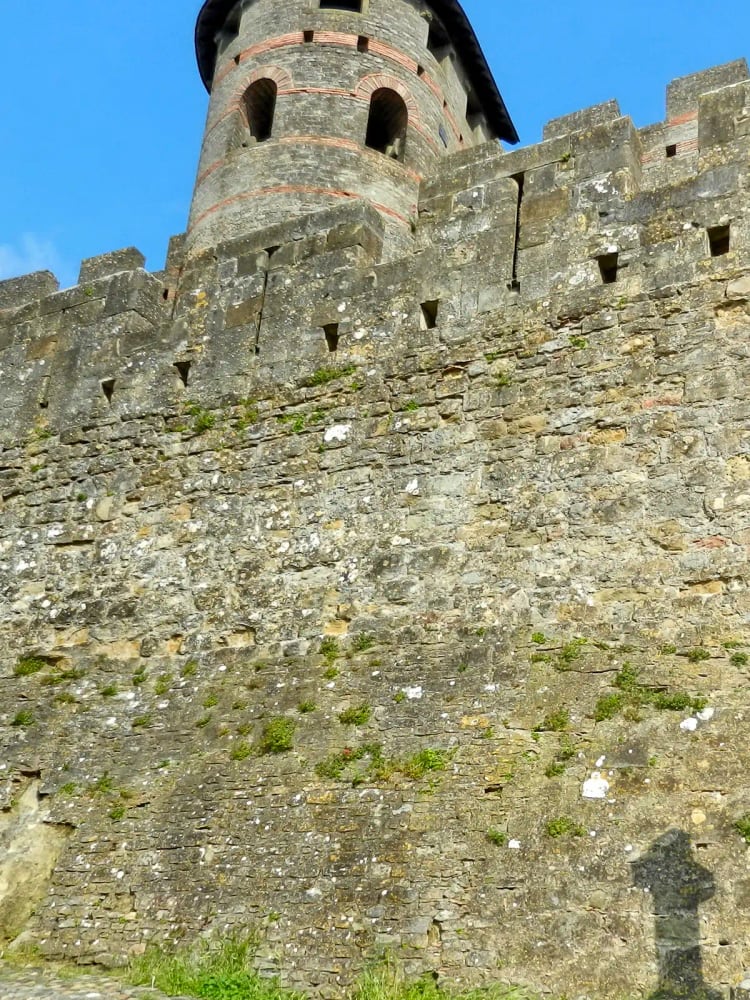
Cité de Carcassonne skip-the-line — Château Comtal and 1,200 metres of double walls above the Aude. The cité itself is free to wander; the castle and ramparts aren't.
See ticket optionsSkip the on-site queue · audio guide included
€35
Same access plus operator audioguide rental
€40
Same access · operator low-season rate
€27
“We turned up at 2pm on a July Saturday — castle queue was 40 minutes. Walked past it with the skip-the-line tickets. First thing worth paying for on a 3-week France trip.”
“Rampart walk is the thing. The Château exhibition is decent but the walk along the inner walls with the Aude below is what you remember. Audio guide was worth the extra 7 euros.”
“Came with three teenagers. None of them were excited. All three of them climbed every tower. The Viollet-le-Duc restoration story got them.”
5-minute audio guide
Hand-written, narrated by a heritage host. Five minutes through 2,500 years of fortification — the Cathar siege, the Albigensian Crusade, Saint Louis's double walls, and Viollet-le-Duc's controversial restoration.
Included free with every ticket. No app, no download — plays in any browser.
Carcassonne was first walled by the Romans in the 3rd century, expanded by the Visigoths, then turned into the French crown's southern fortress after the Albigensian Crusade took it from the Trencavels in 1209. By the 17th century it had lost its strategic value and was falling to ruin.
In the 1850s the architect Eugène Viollet-le-Duc rebuilt the conical roofs, the crenellations, and the outer walls — so the cité you see today is partly 13th-century and partly the most famous 19th-century medieval restoration in Europe. It's the reason the place looks the way fairytales think castles look.
The cité itself — the cobbled lanes, the Basilique St-Nazaire, the shops and restaurants inside — is free to wander. What you pay for is the Château Comtal and the ramparts walk above, run by the French national monuments service (CMN). The view from the tower battlements across the lower town and the vineyard plain is the reason people come.
Cité de Carcassonne Tickets acts as a facilitator to assist international visitors in purchasing skip-the-line tickets directly from the Centre des monuments nationaux (CMN), the official operator of the Château Comtal and ramparts. We do not resell tickets — we provide a personalised booking and support service in your own language. Our concierge service fee is included in the displayed price. For those who prefer to purchase directly, the official ticket site is remparts-carcassonne.fr.
Plan your visit
A month-by-month guide to crowds, weather, the July Festival, the Bastille Day fireworks, and the photography windows that shape a visit to the walled medieval city.
Train, car, and Carcassonne Salvaza airport routes from Toulouse to the Cité — with notes on the walk from the railway station and which option suits which traveller.
Both are UNESCO sites managed by the Centre des monuments nationaux, both are among France's most-visited monuments — but they sit at opposite ends of the country and ask very different things of a visitor.
Priority entry to the Château Comtal (the castle inside the cité), access to the full 1.2 km ramparts walk, and the interior exhibitions. The cité's streets, shops, and the Basilique St-Nazaire are free to wander without a ticket — you only pay for the castle and ramparts.
July–August 11:00–15:00 is the worst. Peak-day castle queues hit 45–60 minutes without a pre-booked ticket. Morning (10:00 open) and late afternoon (after 16:00) are calmer. Skip-the-line cuts any queue to under 5 minutes.
Allow 1.5–2 hours for the Château + ramparts at a steady pace. Add another 1–2 hours if you want to wander the cité's streets, visit the Basilique St-Nazaire, and have lunch inside the walls. Most visitors spend 4 hours total.
No. The cité — the inner walled city with its cobbled streets, shops, restaurants, and the Basilique St-Nazaire — is free to enter and wander. What you pay for is the Château Comtal (the castle) and the ramparts walk above, which is the UNESCO-worthy bit.
Tickets are issued for a specific date and are non-transferable once issued. If your plans change, reply to your confirmation email at least 48 hours before your date and we will rebook your visit to any open slot in the operator's calendar.
Yes — kids 6+ tend to love climbing the towers and walking the ramparts. Under-18s are free at the gate (EU policy); the family tier bundles the paperwork so you skip-the-line together. Strollers struggle on the cobbles; a carrier works better.
Yes, everywhere. No tripods inside the castle exhibitions. Drones prohibited without a CMN permit. The classic postcard shot is from the Pont Vieux across the Aude at blue hour.
Tickets are issued for a specific date and are non-transferable once issued. If your plans change, reply to your confirmation email at least 48 hours before your date and we will rebook your visit to any open slot in the operator's calendar.
The Cité de Carcassonne is a fortified medieval city in the Aude department of southern France, set on a hill above the river Aude. Founded during the Gallo-Roman period and later expanded through the Middle Ages, it is one of Europe's most complete examples of a walled town, ringed by a double line of ramparts roughly three kilometres long and punctuated by fifty-two towers. Within the walls stand the Château Comtal, the twelfth-century castle of the viscounts of Carcassonne, and the Basilica of Saint-Nazaire, whose Romanesque nave and Gothic choir span several centuries of building. By the nineteenth century the fortifications had fallen into ruin, and the architect Eugène Viollet-le-Duc led a celebrated restoration from 1853, adding the distinctive conical tower roofs seen today. The walled city, still inhabited, was inscribed as a UNESCO World Heritage Site in 1997.
The Cité de Carcassonne sits on a hill on the eastern bank of the river Aude, about one and a half kilometres from Carcassonne's main railway station in the lower town. From the station, most visitors walk to the citadel in roughly twenty-five to thirty minutes, crossing the Aude by the Pont Vieux or Pont Neuf for memorable views of the walls; a local bus line and a seasonal shuttle, the navette, also link the station and town centre to the Porte Narbonnaise entrance. By road, the A61 motorway connects Carcassonne with Toulouse to the west and the Mediterranean coast to the east, and paid car parks lie just outside the ramparts. Carcassonne also has its own small airport, Salvaza, code CCF, a short drive from the city, with seasonal flights from several European destinations.